 Assemblage, Expédition et Support de toutes les commandes depuis l'Union Européenne
GPU-Assisted RAID for High-Performance NVMe Storage
GRAID SupremeRAID uses GPU-assisted RAID processing to protect high-performance NVMe storage without placing a traditional RAID controller in the storage payload path.
Broadberry combines GRAID SupremeRAID with qualified NVMe servers, SSDs, processors and networking to design complete storage systems sized around your applications, capacity and performance requirements.
RAID computation is offloaded to the GPU while NVMe data remains on the host PCIe path.
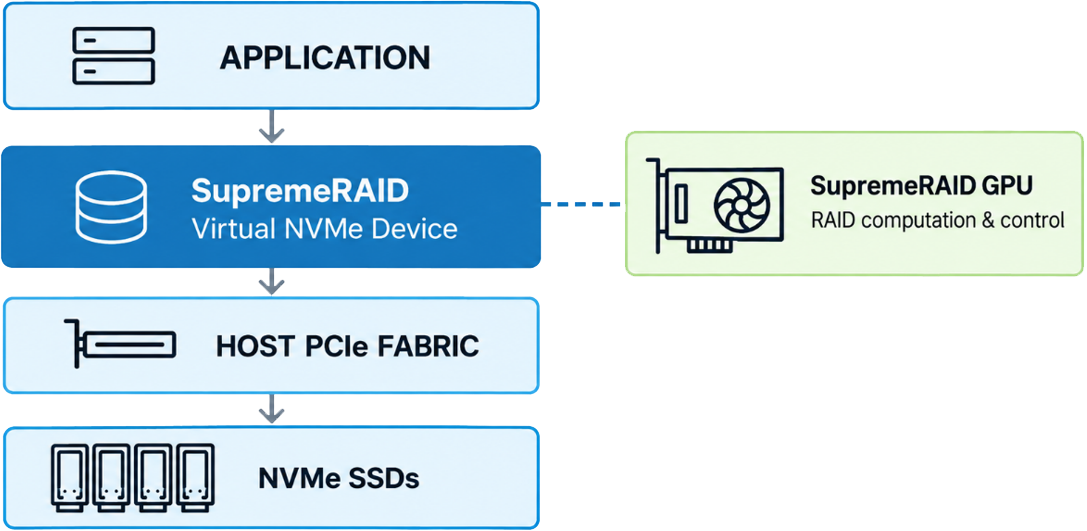
GRAID separates RAID computation from the path used to move application data. NVMe drives remain connected to the host PCIe fabric while SupremeRAID handles RAID computation and presents protected virtual NVMe devices to the operating system.
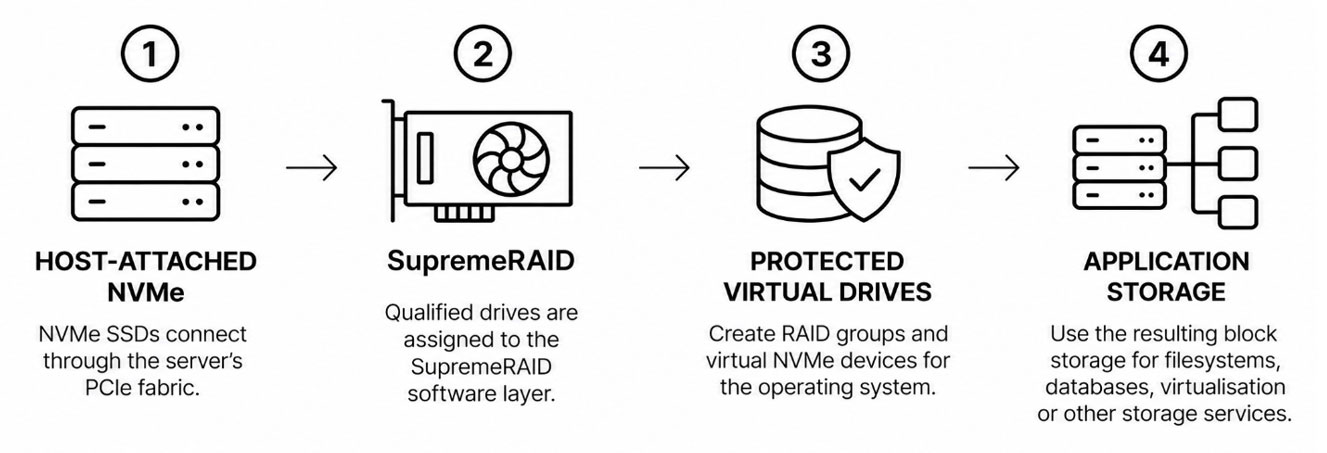
SupremeRAID provides protected block storage. Filesystems, shared storage services and application-level availability are designed separately.
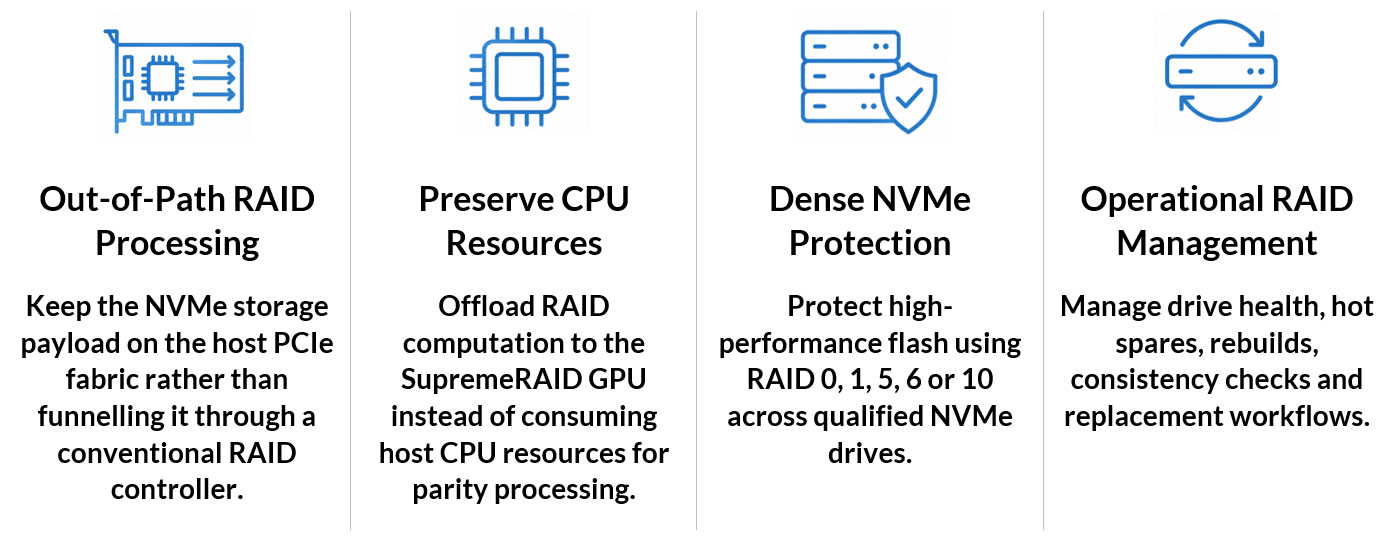
GRAID NVMe storage is suited to applications that need high-performance block storage with drive-level protection. Broadberry selects the RAID policy, SSDs and supporting infrastructure around the application's actual I/O and recovery requirements.
| Workload | Typical I/O | Design Priority |
| Transactional Databases | Small random reads, durable writes and logs | Latency, write policy and recovery |
| AI & Analytics | Parallel reads, ingest and temporary output | Sustained bandwidth and CPU headroom |
| Virtualisation | Mixed random I/O from concurrent VMs | Queue depth, latency and failure behaviour |
| Media & Scientific Computing | Large streams, scratch files and burst writes | Sequential throughput and usable capacity |
Fast Local Storage for Data-Intensive Processing
AI preprocessing, analytics and data-processing workloads can combine parallel reads, ingest and temporary writes. GRAID provides protected NVMe block storage while offloading RAID computation from the host CPU.
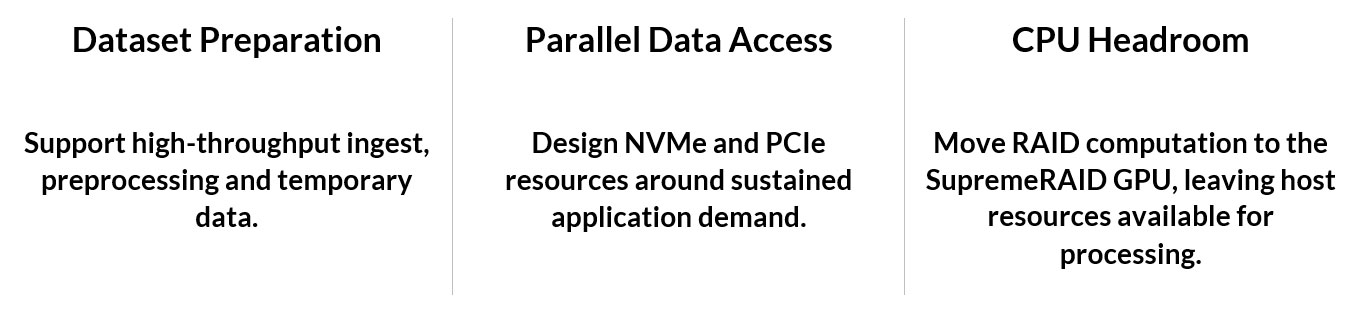
SupremeRAID does not create an AI cluster filesystem. Shared datasets and multi-node access require a separate supported storage architecture.
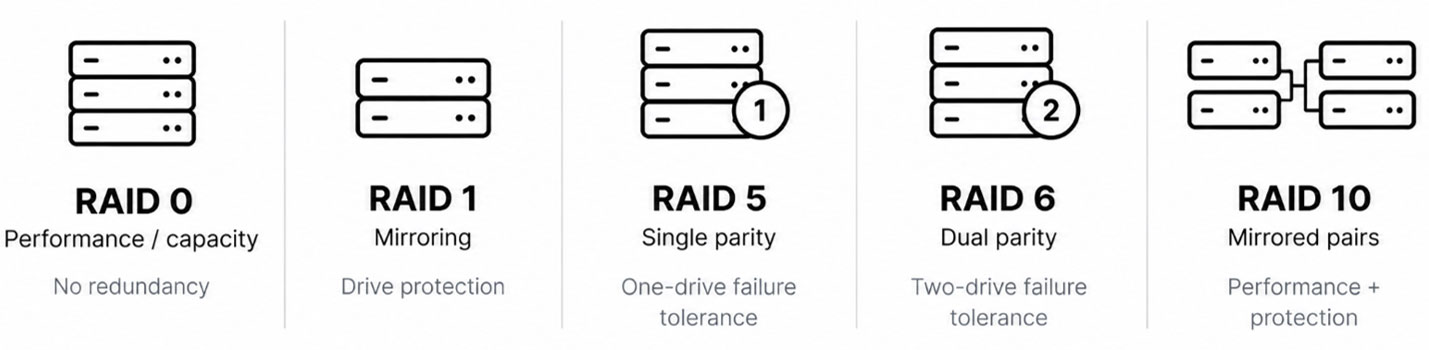
The right RAID level depends on usable capacity, write behaviour, failure tolerance and recovery requirements. Broadberry selects the RAID configuration around the requirements of the workload.
NVMe performance depends on the complete system. Broadberry evaluates drives, PCIe topology, CPU resources and networking together rather than sizing around component specifications alone.
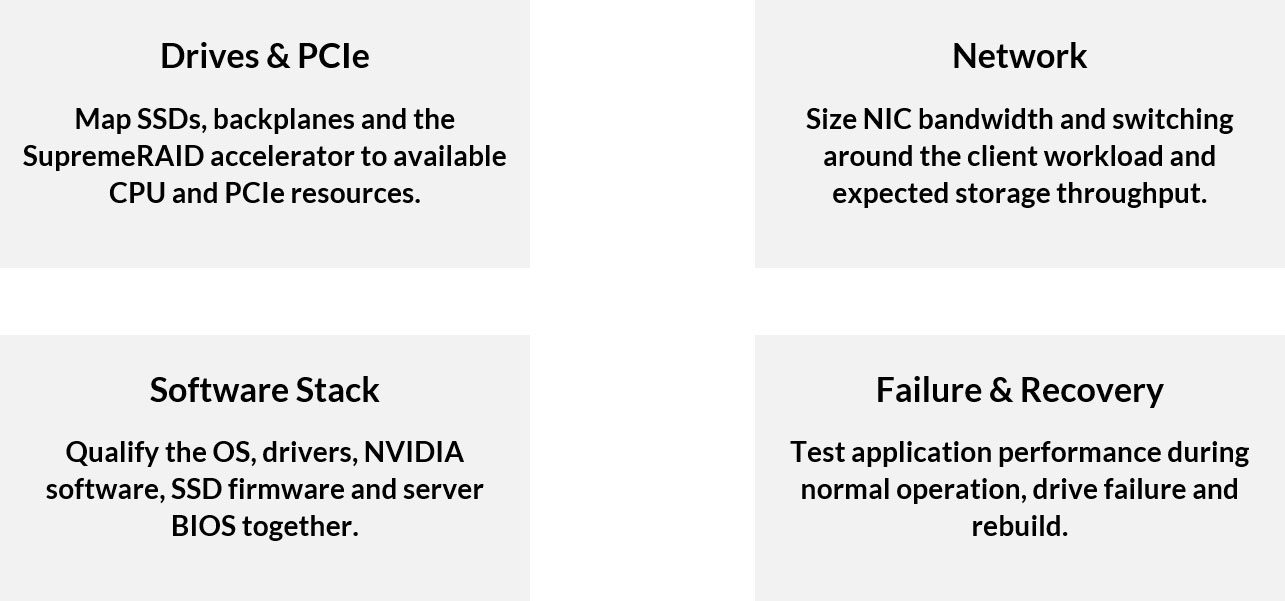
Before recommending a GRAID configuration, Broadberry evaluates the workload, RAID requirements, data path and recovery targets that determine the complete storage design.
Model block sizes, read/write
patterns, queue depth and
concurrency.
Calculate usable capacity,
RAID overhead, spares,
temporary data & growth.
Select RAID level and drive-
group layout around protection
and recovery requirements.
Size NVMe, CPU, memory,
PCIe and network
together.
Test representative
workloads, degraded operation
and rebuild behaviour.
Plan firmware, driver and
software updates, expansion
and ongoing support.
Broadberry designs storage infrastructure around the requirements of the application.

Start with the application's I/O, capacity and recovery requirements.

Select supported servers, NVMe SSDs, GPU RAID hardware and networking.

Engineer storage, PCIe, CPU and network resources together.

Qualification, validation, expansion and ongoing operational support.
What is GRAID NVMe RAID?
GRAID SupremeRAID is a software-defined NVMe RAID platform that uses a GPU to perform RAID computation while NVMe drives remain connected to the host PCIe fabric.
How does GPU-assisted NVMe RAID work?
SupremeRAID uses a dedicated GPU for RAID computation and control. Storage data does not need to pass through card-attached storage ports, allowing NVMe devices to use the host PCIe fabric.
What does the GPU do in a GRAID server?
The GPU handles RAID computation and control. It is not an application accelerator and does not add GPU compute capacity to AI applications.
Which RAID levels does GRAID support?
SupremeRAID Ultra supports RAID 0, 1, 5, 6 and 10. The appropriate configuration depends on usable capacity, write behaviour and recovery requirements.
Does GRAID provide a filesystem or NAS?
No. SupremeRAID provides protected block devices. Filesystems, databases, hypervisors and network storage services run above that block-storage layer.
Is GRAID suitable for AI workloads?
GRAID can provide high-performance protected NVMe storage for AI data preparation, analytics and other processing. It does not itself provide a shared AI cluster filesystem.
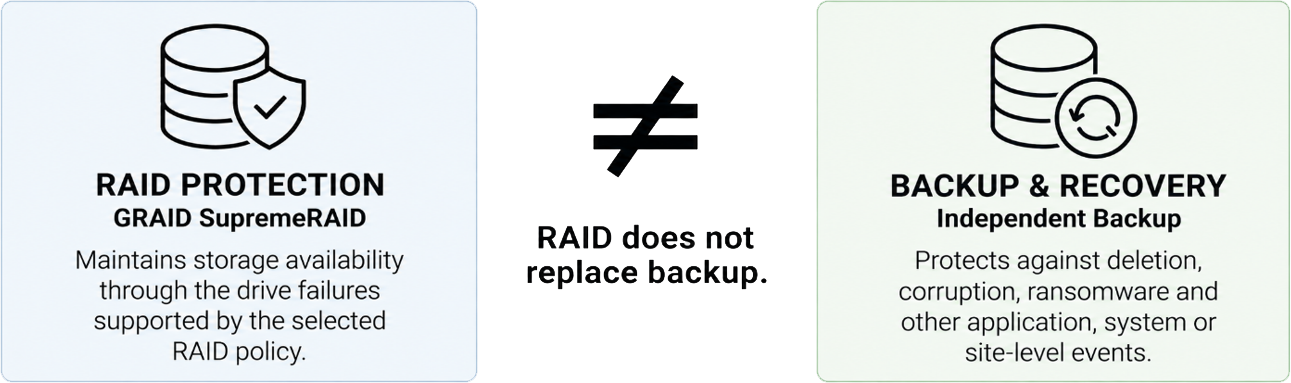
Does GRAID replace backup?
No. RAID protects against specified drive failures. Independent backup is still required for deletion, corruption, ransomware and other recovery scenarios.
How should a GRAID NVMe system be sized?
Start with usable capacity, daily writes, application block sizes, queue depth, concurrency, RAID requirements and recovery targets. Then size NVMe, PCIe, CPU and network resources around the complete application data path.
Tell us about your application, usable-capacity target, I/O requirements and preferred RAID policy. Broadberry can configure the server platform, SupremeRAID, NVMe SSDs and networking as one qualified storage system.

 Notre Procédure de Tests rigoureuse
Avant de quitter nos ateliers, toutes les solutions de serveur et de stockage Broadberry sont soumises à une procédure de test rigoureuse de 48 heures. Ceci, associé à un choix de composants de haute qualité, garantit que toutes nos serveurs et solutions de stockage répondent aux normes de qualité les plus strictes qui nous sont imposées.
 Une Flexibilité Inégalée
Notre principal objectif est d'offrir des serveurs et des solutions de stockage de la plus haute qualité. Nous comprenons que chaque entreprise a des exigences différentes et sommes en mesure d'offrir une flexibilité inégalée dans la personnalisation et la conception de serveurs et de solutions de stockage.
Nous nous sommes imposés comme un incontournable fournisseur de stockage en Europe et fournissons depuis 1989 nos solutions de serveurs et de stockage aux plus grandes marques mondiales. Quelques exemples de clients :


impressum / returns / Mon compte / Contactez-nous / new accounts
CyberServe EPYC EP1-102A
A powerful AMD EPYC rack server for small spaces...
| August 26, 2026
CyberServe Ryzen RY1-104A
A core-heavy Ryzen rack server at an entry-level price ...
| April 01, 2024
CyberServe Xeon SP1-102G NVMe G5
A small, powerful, and affordable rack server.
Broadberry gets edgy with a great value rack server...
| December 01, 2023
Intel M50CYP2UR208 Coyote Pass Server - 8 Drive Bays. SAS/SATA/NVME
A mighty server package for the price with a big helping of blisteringly fast Intel Optane 200 PMEMs...
| August 02, 2021
 Appelez notre équipe commerciale française maintenant
