 Assemblage, Expédition et Support de toutes les commandes depuis l'Union Européenne
Parallel File Storage for HPC, AI and Data-Intensive Workloads
Broadberry Lustre storage provides a shared, high-performance filesystem for Linux compute environments that need to process large datasets in parallel.
From engineering simulation and scientific research to AI training and large-scale analytics, Broadberry designs each Lustre environment around your workload, capacity, metadata, throughput and resilience requirements.
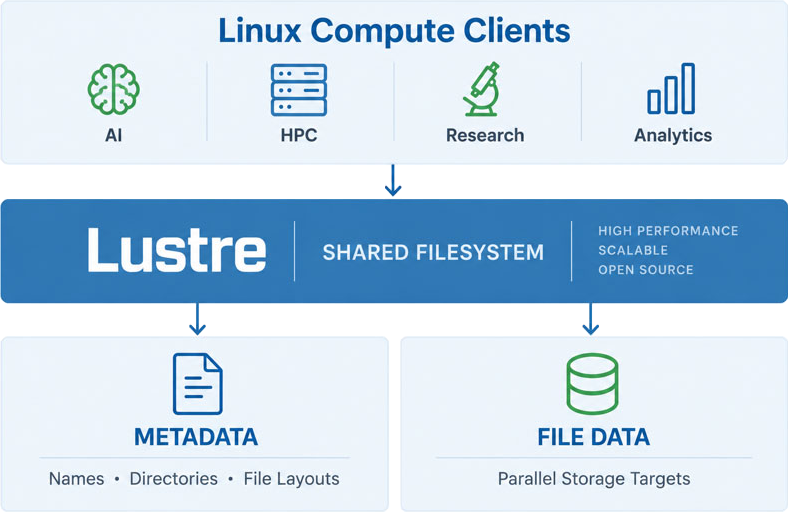
Lustre separates metadata operations from file-data transfers, allowing each part of the storage environment to scale around the workload.
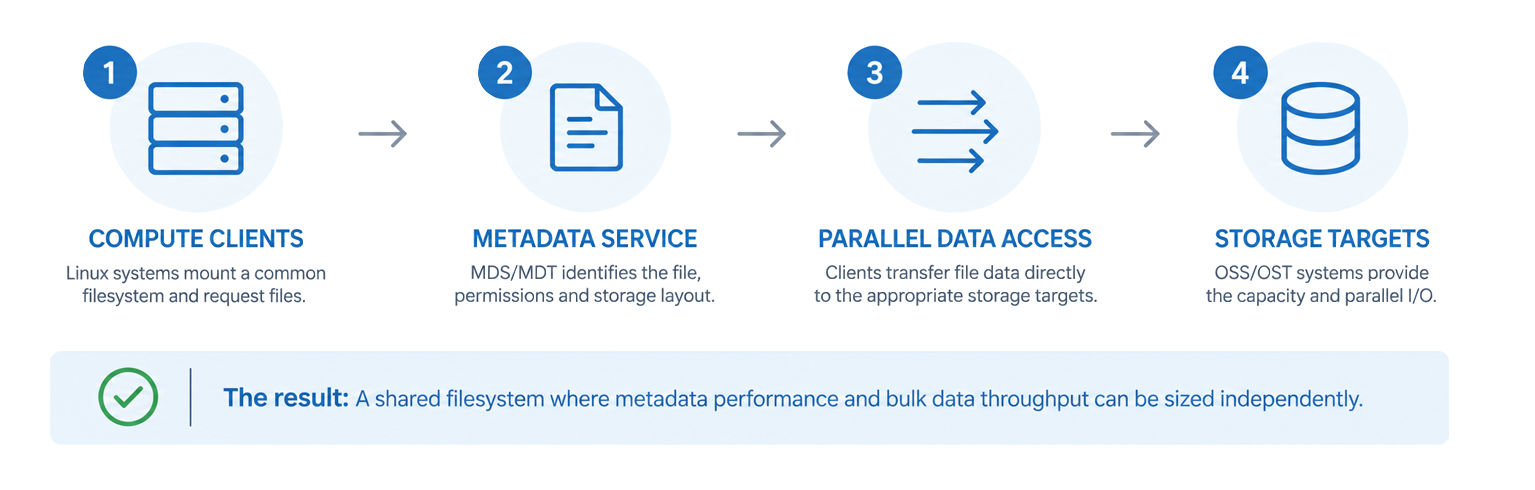
Before recommending a Lustre architecture, Broadberry evaluates how your applications access data, how many clients operate concurrently and where performance bottlenecks are most likely to occur.
Model client count,
concurrency, file sizes and
I/O patterns.
Calculate usable capacity,
protection overhead,
reserve and growth.
Size MDS and MDT resources
around namespace and file
activity.
Engineer storage nodes,
media, networking and
availability.
Test throughput, metadata
performance, failover and
recovery.
Plan expansion, upgrades,
maintenance and ongoing
support.
Different workloads place very different demands on storage. Broadberry sizes Lustre around the application's actual I/O pattern rather than a single peak-bandwidth target.
| Workload | Typical I/O | Design Priority |
| AI Training | Parallel dataset reads and checkpoint writes | Throughput and checkpoint performance |
| Simulation & HPC | Large parallel writes and restart reads | OST bandwidth and protected capacity |
| Research & Life Sciences | Many files, opens and directory operations | Metadata performance |
| Media & Rendering | Concurrent asset reads and output streams | Client fan-in and mixed I/O |
| Large-Scale Analytics | Repeated scans of large datasets | Read throughput and data placement |
Peak storage bandwidth tells only part of the story. Lustre performance depends on the complete data path and the way applications access files.
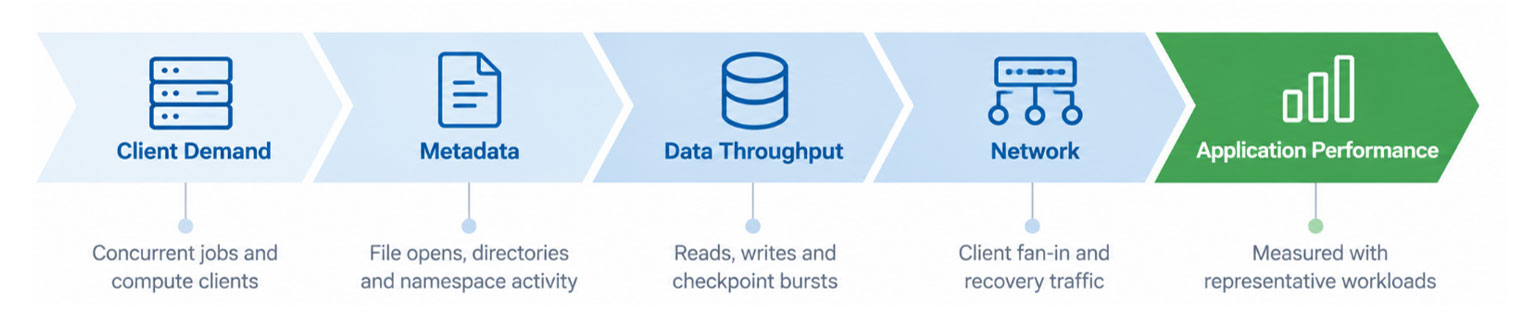
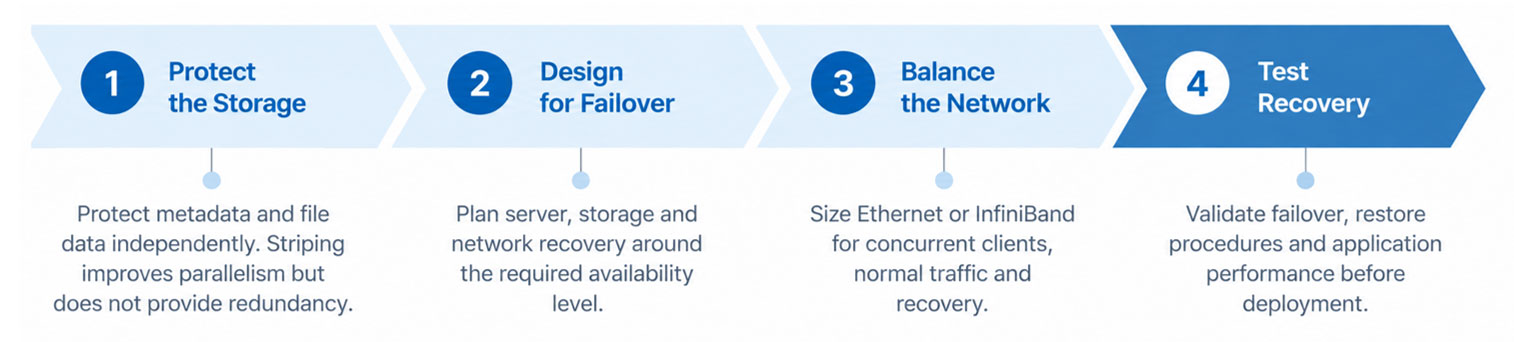
Lustre availability depends on more than the filesystem itself. Broadberry designs storage, networking and recovery together to meet your availability requirements.
Lustre is best suited to compute environments that benefit from shared, concurrent access to large or data-intensive file workloads.
| Use Case | Typical Requirements |
| AI & Machine Learning | Shared training datasets, parallel reads and checkpoint writes |
| Engineering & Simulation | Concurrent solver jobs, large outputs and restart data |
| Research & Life Sciences | Shared project data, large namespaces and mixed file sizes |
| Rendering & Media | Parallel asset reads and output streams |
| Seismic & Analytics | Sustained scans and parallel processing of large datasets |
| Lustre Is a Strong Fit When... | Consider Another Approach When... |
| Many Linux clients need shared file access | Storage is primarily for general office file sharing |
| Aggregate throughput matters | You primarily need VM block storage |
| Applications process large datasets concurrently | Workloads require only modest single-server storage |
| Metadata and bulk I/O need independent scaling | Native Lustre client support isn't practical |
| HPC, AI or research workloads dominate | Simplicity matters more than parallel scale |
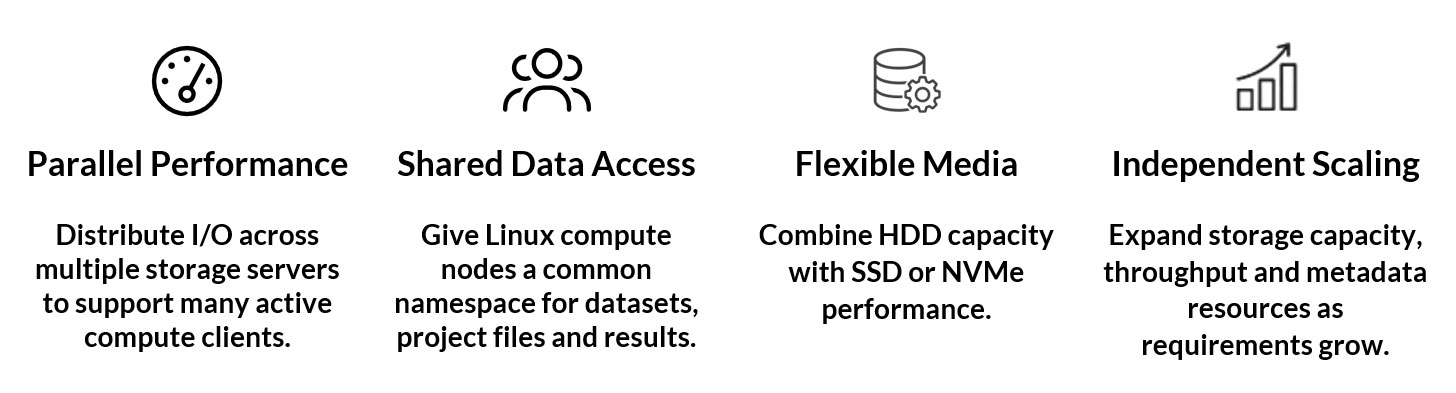
Broadberry combines Lustre architecture expertise with workload-led hardware design to deliver a complete storage platform sized around the way your applications actually access data.

Architecture based on your applications, clients and I/O requirements.

Metadata, storage, compute, media and networking designed together.

Choose HDD, SSD and NVMe configurations.

Qualification, validation, expansion and ongoing operational support.
What is Lustre storage?
Lustre is an open-source parallel filesystem for Linux compute environments. It provides a shared namespace while distributing file data across multiple storage targets, allowing many clients to access shared datasets concurrently.
When should I use Lustre instead of a traditional file server?
Lustre is a strong fit when many compute clients need shared data and the required capacity or aggregate I/O exceeds the practical limits of a single storage server. For modest office file-sharing requirements, its additional complexity may not be justified.
Does Lustre require all-flash storage?
No. Lustre can use HDD, SSD or NVMe targets, or a combination. Media should be selected around capacity, metadata activity, latency and workload performance requirements.
Is Lustre suitable for AI and GPU clusters?
Yes. Lustre can provide shared access to training datasets across GPU servers while supporting parallel dataset reads and checkpoint writes. The architecture should be sized around actual application demand rather than GPU count alone.
Does file striping provide data protection?
No. Striping distributes data across storage targets to improve capacity and I/O parallelism. Data protection and recovery must be provided by the underlying storage and availability architecture.
Can Lustre handle small files?
Yes, with an appropriate metadata and file-layout design. Small-file performance should be tested using representative create, open, stat and delete activity rather than relying on large-file bandwidth tests.
Does a wider stripe always improve performance?
No. Stripe size and count should match the workload. Excessive striping can introduce unnecessary overhead, particularly with smaller files.
Can Lustre storage expand over time?
Yes. Additional storage targets can add capacity and throughput, while metadata resources can scale separately. Existing data placement and migration requirements should be considered as part of expansion planning.
Does Lustre replace backup?
No. Working-space protection and filesystem availability do not replace an independent backup. Backup and archive requirements should be designed separately.
Tell us about your applications, compute clients, usable capacity, file profile and performance requirements. Broadberry will design the metadata, storage and networking architecture around your workload.

 Notre Procédure de Tests rigoureuse
Avant de quitter nos ateliers, toutes les solutions de serveur et de stockage Broadberry sont soumises à une procédure de test rigoureuse de 48 heures. Ceci, associé à un choix de composants de haute qualité, garantit que toutes nos serveurs et solutions de stockage répondent aux normes de qualité les plus strictes qui nous sont imposées.
 Une Flexibilité Inégalée
Notre principal objectif est d'offrir des serveurs et des solutions de stockage de la plus haute qualité. Nous comprenons que chaque entreprise a des exigences différentes et sommes en mesure d'offrir une flexibilité inégalée dans la personnalisation et la conception de serveurs et de solutions de stockage.
Nous nous sommes imposés comme un incontournable fournisseur de stockage en Europe et fournissons depuis 1989 nos solutions de serveurs et de stockage aux plus grandes marques mondiales. Quelques exemples de clients :


impressum / returns / Mon compte / Contactez-nous / new accounts
CyberServe EPYC EP1-102A
A powerful AMD EPYC rack server for small spaces...
| August 26, 2026
CyberServe Ryzen RY1-104A
A core-heavy Ryzen rack server at an entry-level price ...
| April 01, 2024
CyberServe Xeon SP1-102G NVMe G5
A small, powerful, and affordable rack server.
Broadberry gets edgy with a great value rack server...
| December 01, 2023
Intel M50CYP2UR208 Coyote Pass Server - 8 Drive Bays. SAS/SATA/NVME
A mighty server package for the price with a big helping of blisteringly fast Intel Optane 200 PMEMs...
| August 02, 2021
 Appelez notre équipe commerciale française maintenant
